Showing posts with label chicken. Show all posts

Saturday, November 6, 2010

Chicken and Dumplings

I had some frozen chicken breasts that needed to be used up as they were starting to freezer burn. This called for some seriously moist cooking. I also have a sore throat, so soup seemed like the best idea to me.

Chicken and Dumplings
3 large half chicken breasts, boneless and skinless
Several chicken necks
1/2 pound carrots
1/2 pound or so mushrooms
1/2 large onion
1 sprig rosemary
several sprigs thyme
2-3 tablespoons chopped garlic
2-3 bay leaves
20 oz. chicken stock
1 cup Bisquick(tm) baking mix
2.5 oz 2% milk
1/2 tsp garlic powder
Salt to taste

Boil the chicken necks in a gallon of water for about an hour, scumming the fat and flotsam from the surface. I put mine in cheesecloth so I didn't have to retrieve bones and skin.

Once the necks have boiled, remove them from the pan and discard (you could retrieve the meat if you so desire - I was lazy).

Chop carrots, onions, and mushrooms into bite-size pieces and add to pan. Add chopped garlic. Let simmer for an hour or so.

Add chicken breasts (still frozen) and simmer until done. Remove each breast and cut into bite-size pieces and return to pan.

About half an hour before you want to eat, add the salt, rosemary, bay leaves, and thyme.

Fifteen minutes before dinner, mix the baking mix, milk, garlic powder and a pinch or two of salt together. Add to boiling soup in teaspoon (or tablespoon) sized dollops, depending on how large you want your dumplings to be. Simmer for 10-12 minutes, turning over halfway through the cooking.

Of course, this won't be enough dumplings for the entire pot; I knew we'd have leftovers and I will make fresh dumplings for them. Double baking mix and milk quantities for a single sit-down dinner. If you don't like the baking mix I used, or can't get it, substitute your favorite. Adjust the fluid amount accordingly.

I'd forgotten how rich and creamy the dumplings make the soup; noodles never quite achieve the same effect. The dumplings just melted in my mouth. The soup was just velvety as we ate. Just what I wanted when I have a sore throat.

Feel free to add celery or mess with the proportions of vegetables in the soup. I just like a very carroty and mushroomy soup, particularly when I don't feel great. If you have a chicken (or turkey) carcass and time to make your own stock, feel free to omit the chicken breasts, chicken necks, and broth -- I only used them because I didn't have the time to start fully from scratch today.

Monday, June 7, 2010

Creamy Mushroom Chicken

I love making a dish that is so good you don't mind having it for several meals in a row (i.e. dinners in a row). It's even better if the dish is relatively quick and easy to make. This is one of those dishes.

And *gasp* it doesn't even have garlic!

Creamy Mushroom Chicken
2 - 3 pounds of chicken cut into large cubes
1 pound crimini mushrooms sliced
2 oz dried porcini mushrooms
1/2 teaspoon salt
2 cans cream of mushroom soup
1 cup white wine (preferably sparkling or champagne)
3 tablespoons olive oil
2 1/2 cups water

Chop dried porcinis into very small pieces so they need less time to soak and don't have to be chopped while wet. Soak porcini mushrooms in two cups of boiling water for 10-20 minutes (about as long as it takes you to cut up the chicken and mushrooms and brown them).

Sprinkle salt over chicken chunks and let sit for five minutes.

Heat olive oil in large skillet or everyday pan until olive oil is hot and leggy. Brown chicken and remove from pan. Brown mushrooms and remove from pan.

Deglaze pan with wine. Add mushroom soup one can at a time and whisk thoroughly to combine before adding the next can. Rinse cans out with 4-5 ounces of water. Add porcini fluid and porcinis. Add chicken and mushrooms. Cook until chicken is done.

Serve over rice or noodles.


I used cream of mushroom soup as the base because I didn't want to spend huge amounts of time cooking a sauce down. Between the mushrooms in the soup, the mushrooms I added, and the porcinis, the sauce turned out amazingly rich and full of mushroom-y goodness.

I will confess I used a sparkling white wine because I had some left from dinner the night before. It was nicely crisp and dry without being sour and supported the mushroom flavor wonderfully. I think it also helped the sauce be a bit lighter, though I suspect that was mostly in my mind.

Peas work really nicely as a vegetable to serve with the sauce -- I thawed the peas and mixed them into the sauce on my plate. They gave wonderful little bursts of fresh sweetness in the sauce.

Enjoy!

Tuesday, June 1, 2010

Chicken in Milk and Honey

After the weekend I had, I needed to take yesterday really easy. So this is a recipe I developed years ago.

Chicken in Milk and Honey
1 lb chicken cut into serving sizes
2 cups milk
1 tablespoon honey (clover works well)
1 pinch mace
dash of salt

Dissolve honey in milk in a crock pot on medium. Add chicken and spices and simmer in crock pot for several hours. Serve over baked potatoes or noodles.


This is a really easy recipe to prep. The chicken and sauce are mildly sweet, but not overly so. Last time I made it, I served it to 150 people and had absolutely no leftovers. People wandered into the kitchen looking for more!

This recipe works better with lighter honeys. Buckwheat will be far too strong and will overwhelm the chicken. I initially used clover because it's readily available and not overly strong.

It's been a while since I've made this recipe; I think I'll remedy that this week.
When I do, I want to make some tweaks, like browning the chicken before putting in the crock pot and deglazing the pan. I also think it would be lovely with an orange blossom honey.

Monday, October 26, 2009

Cornish Game Hen

One of our local grocery chains (local to the area) every two weeks or so has a themed "13 Hour Sale." Some weeks the theme is baking supplies; others it is wine and cheese; and yet others it is candy. A little while ago, the chain had a 13-Hour Meat Sale.

For the most part, I buy meats as we plan to eat them. Not as economical as it might be, but the meat is fresh, not frozen. I didn't buy much meat this year as the sales weren't as good as they've been in the past, but I did pick up a few Cornish game hens for two dollars each. They were already frozen, so I didn't have to worry about reducing their quality by freezing them.

Not long after the sale, the weather turned colder. When the weather gets cold, I turn on my oven. So I roasted a Cornish game hen for dinner.

As most of you know, roasting meat is basically a balancing game of trying to get the internal temperature to a certain point before the meat dries out. The easiest way to do this is to roast at a relatively high temperature. The standard 350°F (176°C) oven that most people leave their ovens set at just doesn't cut it. The meat gets dry, especially for birds, while the bottom gets greasy. Not terribly appetizing.

The solution is simple: turn that oven UP! Roasting at anything less than 425°F (218°C) is not going to give great results, whether you are cooking a hunk of beef, a turkey, or a meatloaf.

I like to cook my poultry at about 450°F (232°C). The skin of the bird gets nice and crispy and the interior cooks faster than the moisture can evaporate. Yum!

Anyway, back to my Cornish game hen:

Cornish Game Hen
1 Cornish game hen
1/4 large onion, chopped coarsely
2 tablespoons garlic, chopped finely
1 teaspoon of one of the following fresh green herbs chopped finely: sage, rosemary, thyme, tarragon (2 teaspoons of the dried version will work)
1-1/2 teaspoons salt
2 tablespoons butter

Preheat the oven to 450°F (232°C).

Melt the butter.

Clean the interior of the cavity of the bird, removing any giblet packets and any stringy material. Spread the salt along the interior of the cavity. Put the chopped onion, garlic and green herb. Place Cornish game hen on its back in a roasting pan.

Drizzle butter over the skin of the bird.

Roast until the internal temperature reaches 180°F (82°C). Let rest for 10 minutes, remove the stuffing (discard the stuffing), then serve.

Serves 2


I can go either way regarding buttering the skin of the bird. If the bird is particularly thin-skinned, then it really does help keep the breast meat moist (as does roasting the bird on its breast, but then it doesn't look nearly as pretty). I am more likely to butter the skin if I melt the butter, simmer some herbs in it, then strain before applying to the bird. If you do butter the skin, it is more important to get the roasting temperature up so the skin crisps nicely.

If you don't want an herb-y chicken, use zest from and orange or lemon, apple, peach, or nectarine.

The stuffing in the cavity of the bird perfumes the meat wonderfully and leaves no bitterness behind.

Monday, August 24, 2009

Not quite a stir-fry

Late August is a favorite time of year of mine. Nearly all the vegetables I love are in season so I can go to town with them. Sometimes I grill them, sometimes I steam them, and yet other times I stir-fry them. Today I didn't quite do any of those.

Not Quite Stir-fry
2 boneless chicken breast halves
2 small to medium zucchini
1/2 large onion
6-8 crimini mushrooms
2-4 tbsp soy sauce
2 tbsp chopped garlic
1/2 tsp powdered ginger
1/4 cup of water
15 oz rice
1/4 tsp salt
1/4 tsp black pepper
3 tsbp canola oil
1 tsp cornstarch

Slice the onions into slivers. Cut the zucchini into 2-3 inch strips that are a 1/4 inch thick. Cut each mushroom in half and slice. Slice the chicken into 2-3 inch strips 1/4 thick.

Start rice cooking. I will admit that I tend to use a rice cooker; it's more reliable for me than any other method I've tried.

Put the chicken in 2 tsbp of the soy sauce and stir until all is coated. Let marinade until the zucchini is nearly done sauteing.

Add oil to hot skillet. Saute the onions, mushrooms, and zucchini one at a time. Saute the onions until translucent, the mushrooms until they start to brown, and the zucchini until it softens and slightly browns. While sauteing the zucchini, add the salt to the pan to help the moisture rise to the surface.

While the vegetables saute, mix the soy sauce, garlic, and ginger in a food processor until the mixture is smooth. Add two tablespoons of water to mixture.

Once the onions and mushrooms are done, pull the chicken out of the soy sauce and place on a paper towel to drain. Once all the vegetables are done, lay the chicken in a single layer in the skillet. Brown each side. Once all the chicken is browned, remove all the chicken, and deglaze with the remaining water. Add the soy sauce mixture then reintroduce the chicken and vegetables. Simmer for a few minutes, until the zucchini and chicken are cooked.

Mix a tablespoon or so of water with the cornstarch and add. Simmer mixture until sauce has thickened. Serve over the rice.


Ginger and zucchini work really well together as a flavor combination. I was really happy with the way it turned out. It wasn't a stir-fry, per se, as I didn't cook it all the time on high and keep the food moving. I don't care -- it was yummy!

Tuesday, August 18, 2009

Soup starting

That last couple of weeks have been a little challenging. First I was on vacation and got sick, sick, sick. As in sounding like I was hacking up a lung sick -- and I was camping!

Second, I got home and was still sick. Then my partner got home and she got what I had. So chicken noodle soup was the special of the day for this weekend.

Anytime I roast a chicken or debone chicken for another recipe, I immediately make stock. Just chicken and a little salt -- no veggies, no other spices. This way, the chicken stock will be ready to be used anyway I see fit. I can always add the other stuff later.

As I was saying, the chicken broth came in really handy this weekend. I put the frozen broth, a 16 oz bag of frozen peas, a pound of carrots, four celery stalks, a large onion, three bulbs of garlic (keep cloves whole), four bay leaves, a couple of teaspoons of thyme, a teaspoon of black pepper, and a pound of mushrooms in a very large pan. I added five thighs and drumsticks to the mix and covered with water. Then I let it simmer for a couple of hours. After an hour, I pulled the meat, removed the bones, and replaced the meat. I also pulled the top two cups of fluid and set it in the fridge to separate. About half an hour before we wanted to eat, I added the defatted broth and thick country noodles.

The soup was really, really rich with a wonderful, silky mouth-feel. The soup was not really garlicky, probably because I left the cloves whole. I put so much stuff in it that the soup was somewhat stewy (but without a really thick gravy), so it was incredibly filling.

Monday, March 23, 2009

Chicken in Buxom Cream Sauce

I just couldn't figure out what else to call it.

On her way home from work, Julia called to see what I wanted her to get from the grocery store. She wanted chicken in some sort of cream of something sauce and wanted to know if there was anything else I needed. Well, actually mushrooms and cream of something (mushroom) sauce. I had everything else I needed.

I know a lot of people turn up their noses when someone suggests using a cream of something soup as a base for a sauce. I find it saves me a lot of work and hassle; I don't spend hours cooking the cream sauce and risking burning it. Campbell's soups are consistent, so I know how thick and creamy the end product will be. I also know that I will be adding so many other flavors that the base soup won't necessarily be recognizable.

One of my standard chicken in cream of mushroom sauce dishes uses dijon mustard; I don't make it like the recipe the can. I start with cutting up the chicken, sauteeing mushrooms and onions, browning the chicken, then deglazing the pan. But this weekend I ended up watching America's Test Kitchen and it gave me an idea: sharp cheese!


Chicken in Buxom Sauce
1 whole chicken breast cut into 1/2 pieces
3 tablespoons of Worchestershire sauce
1 large white onion, chopped (I only had a half, so that's what I used. I prefer more)
1 lb crimini mushrooms, sliced
2 tablespoons canola oil
1 tablespoon dijon mustard
1/2 tablespoon horseradish sauce
2 cans of cream of mushroom soup
1 cup dry white wine
1 to 1-1/2 cups of water
1/4 to 1/2 cup shredded romano cheese
1/2 teaspoon freshly ground black pepper
1/2 teaspoon kosher salt
2 tablespoons dried garlic
4 medium handfulls egg noodles (good thick noodles, not wimpy curly ones)

Marinade the chicken in the Worchestershire sauce. The chicken should be coated with a little pooling in the bottom of the bowl.

Over high heat, sautee the onions and mushrooms in the canola oil until they carmelize and a dark brown crust begins to form on the bottom of the pan. Once the mushrooms and onions are done, pull out of the pan and set aside.

Drain the chicken, reserving the fluid. Brown the chicken well. Remove chicken and deglaze with half of the wine. Turn the heat to medium low.

Blend the mustard, horseradish, cheese, pepper, remaining wine, and reserved Worchestershire sauce. Add to deglazing wine in skillet. Stir in the cream of mushroom soup until well-blended. Stir in water slowly until blended. Return chicken, mushrooms, and onions to skillet. Stir well.

Stir sauce frequent to prevent burning. Simmer for 30-60 minutes or until sauce has thickened.

When cooking the noodles, add the salt and garlic to the cooking water. Drain thoroughly.

Serve the sauce over the noodles.


The dish turned out awesomely. The sauce was everything I wanted, creamy and savory. While strongly flavored, the mustard, horseradish, and cheese harmonized beautifully. Unfortunately, I had a couple too many irons in the fire while cooking dinner to think about serving a veggie with it. When serving a side vegetable, it needs to be strongly enough flavored to stand up to the strong flavors in the sauce. I recommend steamed broccoli or Brussels sprouts; green beans are too weak and carrots may be too sweet.

Monday, March 2, 2009

Fried Chicken

Julia, being from the South, likes fried chicken. Not the stuff you get from KFC, but really good fried chicken. And it just so happens that I have a kick-butt recipe for it. (Modest, aren't I?)

I start with the standard milk wash. Sometimes I use buttermilk; usually I use 2% milk. Then I dredge it, dunk it in an egg wash, then roll it around in bread crumbs. Pretty boring. I have two tricks that take boring fried chicken to the next level.

First, I like to spice it up! The key to tasty chicken is to build the flavor in layers. You want spices in the milk, in the flour, and in the bread crumbs. I use salt (of course), freshly ground pepper, garlic, sesame seeds, paprika, cayenne pepper, and Tabasco sauce. Sometimes I add cumin and coriander. I will warn you right now that the amounts below are approximations. How much of any given spice I use varies based on my mood. In general, I like a fairly garlic-heavy fried chicken and a fairly light hot peppery chicken.

Second, I use Panko bread crumbs. I really like the texture they give the fried chicken. They are really, really crispy, and taste great. I find regular crumbs are a little flat both in texture and taste.


Fried Chicken
2 chicken breast halves
2 cups of milk (enough to cover the chicken)
4 to 5 tablespoons garlic powder
3 to 4 teaspoons salt
1 to 2 teaspoons freshly ground pepper
2 to 3 tablespoons sesame seeds
4 to 5 drops Tabasco sauce
1 to 2 teaspoons paprika
1/4 to 1/2 teaspoon of cayenne pepper
1 teaspoon cumin (optional)
1 teaspoon coriander (optional)
1/2 cup of all-purpose flour
2 eggs
1 to 1-1/2 cups of Panko bread crumbs
1 to 2 cups of canola oil (enough to fill your skillet about an inch deep)

Cut the chicken breast into pieces. I like break it into four pieces -- two thick and two thin. I'll start the thick pieces before the thin and get them to finish about the same time.

Put the milk, Tabasco, 1/4 of the salt, 2 teaspoons of garlic, and 1/3 to 1/2 of the remaining spices, except the sesame seeds. Mix well and add the chicken. Let sit for a minimum of 15 minutes.

Grind half of the sesame seeds into powder. In a second bowl, add half of the remaining salt, all of the remaining spices to the flour. The flour mixture will be very spice heavy.

Beat the two eggs and place in a third bowl.

In a fourth bowl, add the Panko bread crumbs, the remaining salt, and the unground sesame seeds. I don't add powdered spices to this because they tend not to mix in well.

Begin heating the oil at medium high. Dredge each piece of chicken in the flour, coating well, dip into the egg wash, then dredge in the bread crumbs, coating well. Once the oil is hot enough that water dances, start adding the chicken, thickest piece first. Once the first side browns lightly, turn the chicken over. Once the second side browns, turn over again. Continue frying and turning until each piece is done. If the chicken is left on a side too long, the side in the oil will get overly brown before the inside is done.

Once a piece is done, place on a rack to drain. Let rest for five minutes.
The chicken is wonderfully crispy with a nice nuttiness from the sesame seeds. The Panko bread crumbs get a deep golden brown without getting oily. By putting most of the spicing in the flour, the spices retain their punch without burning or turning bitter.

I like frying the chicken in canola oil because the oil has a relatively high smoke-point and is neutral in flavor. The flavor of the chicken and spices really shine through. The key to keeping the chicken breading from burning is to turn the chicken frequently once it has gotten brown.

I often serve the chicken with mashed potatoes or oven-fried potatoes and a steamed veggie like broccoli. The veggie makes me feel virtuous, like I'm eating healthily.

Monday, February 9, 2009

Roasted Chicken and Roasted Vegetable Soup

Well, after I roasted the chicken (see previous post), I had a wonderful idea: roasted chicken and vegetable soup. I didn't want to waste any of the deliciousness that was the chicken.

I took the carcass from the chicken I roasted, pulled off any remaining large chunks meat, then boiled the carcass. I also scraped all the jelly off the serving platter (that's where a lot of the gelatin pools) and added it to the broth . I then roasted up some veggies for the soup.


Roasted Chicken and Vegetable Soup

1 5 lb chicken carcass
4 cups of noodles (thick, dumpling-like noodles work best)
3/4 inch piece of fresh ginger
1/2 pound of carrots
1 large turnip
1 medium onion
3/4 pound of mushrooms (preferably crimini)
1/2 cup of extra-virgin olive oil
3 bay leaves
3 tablespoons of chopped garlic
1 tablespoon of sesame seeds
1/2 tablespoon of ground cumin
freshly ground black pepper to taste
1 tablespoon of balsamic vinegar
Water

Preheat oven to 450°F (232°C).

While roasting the chicken, put the giblets and neck in a pan to boil. This can be done ahead of time. Once the chicken is roasted, remove the large cuts of meat from the carcass. Reserve some of the roasted meat for soup; use or freeze the remainder.

Put the carcass and skin in the pan with the giblets and neck and simmer. As the carcass simmers, regularly scum away the froth and fat that collects on the top of the broth.

Chop carrots, turnip, onion, and mushrooms into bite-size pieces. Drizzle olive oil and 1/2 teaspoon of salt over the vegetables and mix until all of the vegetables are coated. Coat a baking sheet with sides with olive oil (a sheet of aluminum foil can be placed in the bottom of the sheet and oiled for easier cleaning). Put vegetables in the sheet. Roast until nearly done, about 1/2 hour or so.

Once the stock has simmered for a few hours, strain the chicken carcass out of the stock. Remove useful meat from the carcass and return to the broth. Add the vegetables and vinegar.

Simmer for an hour. Continue scumming any froth or floating fat. Add noodles and cook until noodles are done. Enjoy!
This soup can be made with roasted potatoes in addition to or instead of the noodles. I don't like my soups too starchy, so I only use one starch. When I make chicken soup, I prefer noodles. When we moved to Spokane, I discovered Country Pasta, a brand of noodles that are much, much thicker than standard egg noodles, at Costco. I love the texture they bring, dense and chewy, almost dumpling-like.

The soup turned out really, really well. The balsamic vinegar really highlighted the roasted flavors of the chicken and vegetables without making the soup sour or tangy. I roasted the vegetables until they were done and they were good, but I think taking them out of the oven while they are still al dente will make the soup a little more flavorful without making the veggies mushy.

Monday, February 2, 2009

One-oven Meals

As I stated a few weeks ago, I love to roast! I will roast beef, chicken, lamb, pork, potatoes, vegetables, apples -- just about anything. The weather recently turned colder (our lows are about to go below zero again!), so I wanted to heat up the downstairs without using too much electricity. Using the oven allowed me to make dinner and heat up the house.

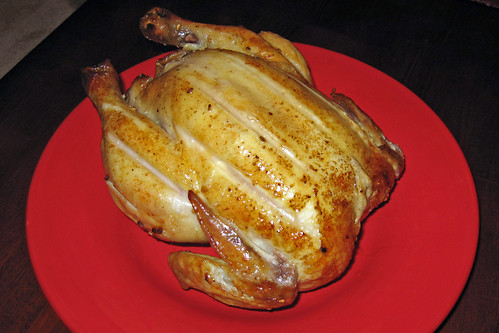
Dinner was roasted chicken stuffed with aromatics and roasted veggies. The house smells amazing.

Roasted Chicken
5 lb chicken, whole
1/2 medium onion
3-4 tablespoons chopped garlic
1-inch piece of fresh ginger
1 teaspoon cumin seeds, whole
2 teaspoons sesame seeds, whole
1/2 teaspoon black peppercorns, whole
1-2 teaspoons kosher salt
2-3 teaspoons olive oil

Preheat oven to 450°F (232°C).

Chop the onion into large pieces, approximately 1-inch pieces. Slice the ginger into thick slices. Toast the cumin and sesame seeds in a small skillet on low heat until the seeds turn brown. Mix the aromatics together.

Clean the neck and giblets, large gobs of fat, and extra viscera out of the cavity of the chicken. Oil the chicken skin with a little olive oil. Stuff the chicken with the aromatics. Place chicken breast down on a roasting rack in a roasting pan (or cookie sheet with sides). Roast until the chicken reaches 180°F (82°C) -- about 15 minutes to the pound. Test the doneness of the chicken by temp, not time or "jiggle test." Rest the chicken at least 15 minutes.

If the chicken breast does not get brown enough, turn the chicken over once it reaches 150
°F (65°C) and finish roasting. I often don't turn the chicken if there is a lot of air circulation around the bird.
2009 01 24 roast chicken

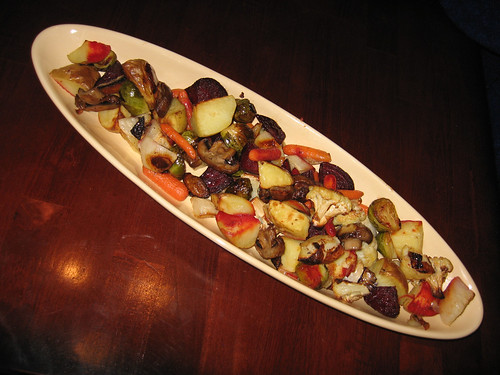
Roasted Vegetables
1/4 to 1/2 pound carrots (baby carrots preferred)
4 large crimini mushrooms
1 med to large turnip
1 med to large beet
8 brussel sprouts
1/2 med onion
1/4 head of cauliflower
2 med to large potatoes (I prefer white potatoes, though russets and yukon golds will work as well)
1/4 to 1/2 cup olive oil
1 teaspoon kosher salt

Wash the vegetables well. Peel the onion, beet, and turnip; I like the potatoes with the skin. Chop all the vegetables into bite-size pieces.

Oil a cookie sheet with sides. Drizzle the vegetables with oil and sprinkle the salt on them. Toss the veggies in the oil until all the vegetables are coated (if you cut smaller pieces than I did, you might need more oil). Spread out on cookie sheet into single layer. The beets will bleed onto other vegetables. If this is an issue, roast the beets on a separate cookie sheet.

Roast at 450°F (232°C) for 30-45 minutes until the vegetables are tender. Add pepper, garlic, or other herbs to taste.
2009 01 24 roast veggies


Yes, the house got wonderfully warm and yummy-smelling. I enjoyed the cooking/smelling process as much as the eating process.

To cook everything in a single oven, you need to put the bottom rack nearly to the lowest setting and the top rack almost to the top. The more space between the racks, the more air circulation you have. In addition, try to make sure the top disk is smaller than the bottom dish. Again, this will help with air circulation so your chicken will roast and not steam.

The chicken was amazingly tender and juicy. By roasting it breast down, the chicken was self-basting and the breast never got a chance to dry out. In addition, the dark meat was juicy, but not greasy. Unfortunately, the breast didn't brown the way I wanted -- I should have oiled the breast and turned the chicken over. That would also have prevented the chicken from sticking to the roasting rack (not too much of a problem).

The veggies, on the other hand, were pretty spot-on. Wonderful Maillard reactions and caramelized vegetable sugars. The cauliflower and the brussel sprouts did incredibly well -- they got sweeter and less cabbage-y.
The potatoes and turnips were sweet and creamy.

And, in the interest of getting the most out of everything, I get to make chicken stock from the carcass!